

Scope: this is general information for independent and used car dealers. It is not legal advice. Confirm specifics with your compliance counsel before changing your advertising or buyer's order.
On March 13, 2026, the Federal Trade Commission sent warning letters to 97 auto dealer groups telling them the price they advertise has to be the price the customer pays. Doc fees, dealer prep, electronic filing fees, "market adjustments" – if the customer cannot walk out without paying it, it belongs in the advertised price. The only line items the FTC lets you leave out of the headline number are government taxes and government registration fees.
The crackdown is built on Section 5 of the FTC Act, which has been on the books since 1914 and prohibits "unfair or deceptive acts or practices." The auto-specific CARS Rule was vacated by the Fifth Circuit in January 2025, but the FTC did not slow down. It went back to using Section 5, which is what it has used to win the cases below. State doc fee statutes do not preempt Section 5, and the FTC has said so publicly.
If you sell used cars, this applies to you the same way it applies to a Chevrolet store. The 97 letters went to franchise groups, but the legal theory is identical for independents.
What "all-in price" actually means
The FTC's standard is that the most prominent price on every ad must include every charge the buyer cannot decline. That gives you a short list of what stays out: state and local sales tax, title fee paid to the DMV, and registration paid to the DMV. Everything else goes in.
That includes:
- Doc fees (called "documentation," "documentary preparation," "processing," whatever your state lets you call them)
- Dealer prep, reconditioning, or inspection charges
- Electronic title and registration filing fees you pass through to the buyer (CVR, Vitu, DealerTrack, etc.)
- Required protection packages, theft etch, nitrogen, pinstripes, or anything pre-installed that the buyer cannot remove from the deal
- Any "market adjustment" or addendum sticker amount
You can still itemize the doc fee on the buyer's order. Most state statutes require you to. The point is that the headline price – the one in your Facebook Marketplace ad, on your VDP, on the windshield – already has it baked in.
🚨 Here's A Test! 🚨
If a buyer points at the window sticker and says "I'll pay that price right now," and you would refuse the deal, the window sticker price is wrong.
State doc fee laws do not save you
This is the part most dealers get wrong. A state law that lets you charge a $799 doc fee, or that requires you to disclose it on the buyer's order, is not the same as federal permission to advertise a price that excludes it. State authorization controls what you can charge. Section 5 of the FTC Act controls how you have to advertise it. They are two separate questions.
The FTC made this point directly at the April 17, 2026 NADA webinar: doc fees are mandatory dealer-imposed charges and have to be in the most prominent advertised price in all 50 states.
The six practices the FTC called out by name
The March 2026 warning letters list the specific behaviors that draw enforcement. Read this list against your own ads:
- Advertising a price that does not reflect all required fees
- Advertising a price that includes rebates or discounts not available to every consumer (military, college grad, loyalty, conquest)
- Advertising a price that ignores a required down payment to actually qualify
- Conditioning the advertised price on the customer using your financing
- Requiring the customer to buy add-ons that are not in the advertised price
- Advertising vehicles that do not exist or are not available for sale
Number 6 is worth dwelling on for used dealers. If a unit sold yesterday and is still live on Cars.com or your own SRP this morning, that is a Section 5 violation by the FTC's own framing – "advertising unavailable or non-existent vehicles." Stale inventory feeds are not just a CRM problem anymore.
What the cases look like in practice
The FTC's letters cite three pending or recent enforcement actions as the templates:
- Lindsay Chevrolet (Maryland), December 2024. A $75 million joint action with the Maryland Attorney General. The FTC alleged Lindsay advertised low prices, then forced unwanted add-ons that pushed the actual deal thousands of dollars higher. The order requires monetary relief plus years of compliance reporting.
- Leader Automotive Group (Illinois), December 2024. Illinois AG joint action over hidden fees, add-ons, and discriminatory financing markups.
- Asbury Automotive Group, August 2024. FTC action over discriminatory fees charged disproportionately to Black and Latino customers.
The Lindsay order is the one to study. The bulk of the alleged conduct – advertising a low price, then sliding $1,500-$3,000 in pre-installed "appearance packages" or theft protection into the deal – is exactly the kind of thing an independent used dealer can fall into without thinking of it as deceptive. If it is bolted to the car when the customer arrives, and they cannot have the car without it, the cost belongs in the ad.
Civil penalties under Section 5 currently run up to $50,120 per violation, per the FTC's own Penalty Offenses page. The FTC has been treating each ad and each customer as a separate violation. The math gets ugly fast on a 200-car lot.
Used dealer compliance checklist
A practical pass through the systems most independents actually use.
✅ Make the all-in price the headline number on every channel
The biggest, most prominent number on the listing has to be the all-in price: Sale Price + Doc Fee + any required add-on. Government taxes and DMV fees are the only things that can be left out, and only if you say so in the disclosure.
A breakdown pop-up or "Pricing details" panel is fine – even helpful – as long as the headline number is already correct. The violation is not having a breakdown somewhere; it is showing a smaller number on top and burying the rest underneath.
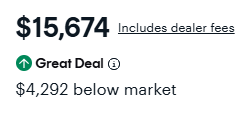
A compliant CARFAX or CarGurus listing looks like this: the prominent price is the total ($15,674 in the example we audited recently), labeled "Includes dealer fees," with a "Pricing details" pop-up that shows the $14,995 vehicle price and the $679 doc fee broken out, plus the standard footnote: "This total does not include taxes, registration, or other government fees." That is the pattern. The $15,674 is what the customer sees first; the $14,995 is just the math.
✅ Lead with the all-in price on your own SRP and VDP
The price on your SRP card and on the VDP should be the all-in number. If your DMS pushes a "list price" of $14,995 and that is what shows up on the search results page – with the doc fee living on a tab three clicks deep – you are out of compliance even if the math eventually adds up. The headline has to carry the load.
✅ Set the doc fee in one place per third-party site
Each platform handles doc fees differently in its feed spec. CARFAX and CarGurus calculate the displayed Total Price themselves by adding the doc fee from your dealer profile to the base price in your feed. That is why the screenshot shows $14,995 + $679 = $15,674. The platform did the math; you set the inputs.
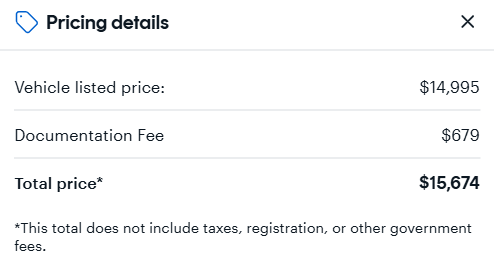
The trap: if you send a feed price that already includes the doc fee, and your dealer profile also has a doc fee set, the platform adds the fee a second time. Your listing then shows up several hundred dollars over your actual price and you lose the click to a competitor. Pick one place – the feed or the profile – and stick to it. For most dealers, the right setup is base price in the feed and doc fee in the profile, then let the platform display the total.
Audit step: log into each aggregator, confirm the doc fee on your profile matches the doc fee on your buyer's order, and confirm your feed is sending base price (not total). If the doc fee on your profile is wrong, every listing on that site is wrong.
✅ Type the all-in number on Facebook Marketplace and Craigslist
No automated doc fee handling. Whatever number you type is the headline price, and that number has to match what the customer pays at the desk minus tax and DMV. If you post at $14,995 and the buyer's order says $15,674 because of a $679 doc fee, that listing is the one the FTC cites. On these platforms, type the all-in number ($15,674) and put the breakdown in the description if you want.
✅ Pull sold units from every feed within 24 hours
Set a daily process to remove sold or transferred units from every channel. If you cannot do it manually, your DMS or website vendor should be doing it.
✅ Itemize the doc fee on every buyer's order
Itemize doc fee, electronic filing, and any other dealer charges on a separate line. State law usually requires this, and it makes the advertised price tie out cleanly: Headline Price = Sale Price + Doc Fee, then plus tax, title, and registration.
✅ Train your sales floor to quote the all-in number first
A salesperson telling a customer over the phone that the car is "$14,995 plus fees" is itself an advertisement under Section 5. Train the floor to quote the all-in number first, then break it down.
The five-minute test you can run today
Open a private browser window. Pull up your three highest-priced units on your own SRP, then on each third-party listing site you use. Write down the price the customer sees. Then pull the buyer's order template you would write up if a customer walked in and bought that unit cash, and compare. Subtract sales tax, DMV title, and DMV registration. If the remaining number is more than $1 over your displayed price on any site, that listing is the one to fix first.
The same test, run against the 97 dealer groups in March, is what got those letters sent. The FTC is not running a sting operation. They are typing addresses into Google.
What we do for KGI dealer clients
We pull the doc fee from your DMS automatically and apply it to the displayed price on your website, so your local SRP and VDP show the all-in number without you touching anything. We do not control the doc fee field on your CarGurus or CARFAX dealer profile – those are your accounts. Log in, set the doc fee there to match what your DMS sends us, and your numbers will line up across every channel. If you are a current client and want us to walk through your aggregator settings with you, reply to your account manager and we will book 15 minutes.
If you are not a client and you want a free pass through your inventory feed for the four issues above, email kgi.solutions.llc@gmail.com with your dealer name and we will send back a written audit within three business days.
Sources
- FTC press release, "FTC Warns 97 Auto Dealership Groups About Deceptive Pricing," March 13, 2026: https://www.ftc.gov/news-events/news/press-releases/2026/03/ftc-warns-97-auto-dealership-groups-about-deceptive-pricing
- FTC template warning letter to auto dealers (March 2026): https://www.ftc.gov/legal-library/browse/warning-letters/template-auto-warning-letter
- FTC and Maryland AG action against Lindsay Chevrolet, December 2024: https://www.ftc.gov/news-events/news/press-releases/2024/12/ftc-maryland-attorney-general-act-stop-lindsay-auto-falsely-touting-low-prices-overcharging
- FTC and Illinois AG action against Leader Automotive Group, December 2024: https://www.ftc.gov/news-events/news/press-releases/2024/12/ftc-illinois-take-action-against-leader-automotive-group-overcharging-deceiving-consumers-through
- FTC action against Asbury Automotive Group, August 2024: https://www.ftc.gov/news-events/news/press-releases/2024/08/ftc-takes-action-against-auto-dealer-group-asbury-automotive-discriminating-against-black-latino
- Section 5 of the FTC Act, 15 U.S.C. § 45: https://www.law.cornell.edu/uscode/text/15/45
- FTC Notices of Penalty Offenses (current civil penalty amount): https://www.ftc.gov/enforcement/penalty-offenses
- FTC consumer guidance on buying a used car: https://consumer.ftc.gov/articles/buying-used-car-dealer
- Trade Regulation Rule on Unfair or Deceptive Fees (16 CFR Part 464), final rule: https://www.federalregister.gov/documents/2025/01/10/2024-30293/trade-regulation-rule-on-unfair-or-deceptive-fees (note: the final rule does not directly cover motor vehicle dealers, but the FTC has said its disclosure principles inform Section 5 enforcement against dealers)